
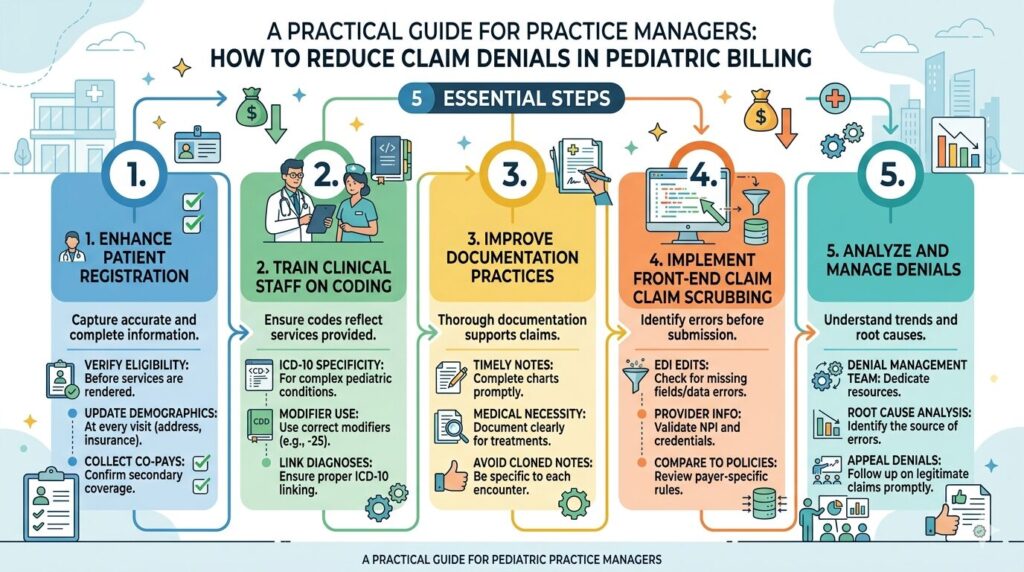
How to Reduce Claim Denials in Pediatric Billing: A Practical Guide for Practice Managers
Pediatric billing comes with its own set of landmines — and if you’re not navigating them carefully, your practice is almost certainly leaving money on the table. Learning how to reduce claim denials in pediatric billing is one of the highest-leverage things a pediatric practice manager or physician can do to protect and grow revenue.
I’m Jyoti, founder of RevantaRCM and a Certified Medical Billing and Coding Specialist with over 10 years of hands-on experience. I’ve worked with pediatric practices across Georgia, Florida, and Texas, and the denial patterns I see are remarkably consistent — which means the solutions are too.
This guide will show you exactly where pediatric claim denials come from, why they’re so persistent, and what your practice can do right now to reduce them.
Why Pediatric Practices Face Unique Billing Challenges
Pediatric billing is distinct from adult medicine in ways that directly affect denial rates. You’re dealing with a predominantly Medicaid population in many markets, age-specific coding requirements, vaccine administration billing rules, and the complexity of billing preventive services alongside sick visits.
Add in the fact that pediatric patients often have both a primary insurance and Medicaid as secondary coverage — and that coordination of benefits errors are extremely common — and you have a billing environment that requires constant attention.
The Medicaid Factor
Many pediatric practices have a patient population where 40–60% or more of visits are covered by Medicaid or CHIP. Medicaid billing has its own rules: EPSDT (Early and Periodic Screening, Diagnostic, and Treatment) requirements, state-specific fee schedules, and managed care organization policies that vary even within a single state program.
The Medicaid EPSDT program is designed to ensure children receive comprehensive preventive care — but billing it correctly requires knowing exactly what’s covered, how to code it, and when to use EPSDT-specific procedure codes versus standard CPT codes.
Well-Child Visit Complexity
Well-child visits (preventive medicine services, CPT 99381–99395) are the backbone of pediatric revenue. But they’re also a frequent source of denials when sick visit services are billed on the same day without the proper modifier, when the age range doesn’t match the CPT code selected, or when the documentation doesn’t support the level of preventive service billed.
Billing a well-child visit and a separate E/M for a problem addressed during the same encounter requires modifier -25 on the problem-focused E/M — and the documentation must clearly show two separate, medically necessary services. Miss that modifier, and the additional E/M gets denied automatically.
The Top Denial Triggers in Pediatric Billing
Let me walk you through the denial categories I see most consistently in pediatric practices.
1. Vaccine Administration Billing Errors
Vaccine billing is one of the most denial-prone areas in pediatrics. There are two components to every vaccine encounter: the vaccine product itself (the supply code, e.g., 90700 for DTaP) and the administration code (90460 or 90461 for patients through age 18 when counseling is provided, or 90471/90472 for patients without counseling).
Common errors include:
- Using 90471/90472 instead of 90460/90461 for pediatric patients when counseling was documented
- Billing the wrong number of administration codes for multi-component vaccines
- Billing vaccines administered under the Vaccines for Children (VFC) program incorrectly
- Failing to include the appropriate diagnosis code linking immunization status to medical necessity
The Vaccines for Children program, administered through the CDC, provides free vaccines to eligible children — but the billing for administration fees is handled separately and must follow strict documentation requirements.
2. Age-Specific Code Mismatches
Preventive medicine CPT codes are age-stratified. A code for a 12-year-old patient billed for an 18-year-old will be denied. A newborn visit code billed for a 3-month-old is wrong. This sounds basic, but in busy practices where billing is done in batches, these mismatches happen more than you’d think.
Build a validation step into your billing workflow: the date of birth on the claim must align with the age range specified by the CPT code billed. Your practice management system should be flagging these automatically — if it isn’t, that’s worth investigating.
3. Coordination of Benefits (COB) Denials
When a child has both private insurance and Medicaid as secondary, claims must be submitted to the primary payer first. The EOB from the primary must accompany the Medicaid claim, and the secondary claim must be submitted with the correct billing amounts reflecting what the primary paid.
Errors in this chain — submitting to Medicaid first, submitting without the primary EOB, or billing the full charge instead of the patient’s remaining balance — result in automatic denials. COB errors are one of the most common denial types in pediatric Medicaid billing.
4. Missing or Incorrect Referrals and Authorizations
For pediatric patients in HMO plans, referrals from the primary care pediatrician are often required before a specialist can bill. When a claim arrives at a specialist’s office without a valid referral on file, it gets denied — even if the care was appropriate and well-documented.
Track authorization requirements by payer and by service type. Build a pre-authorization checklist into your scheduling workflow so your team captures this before the patient is seen, not after.
5. Developmental Screening Billing Errors
Developmental and behavioral screening codes (96110, 96127) are frequently billed incorrectly or overlooked entirely. Many payers have specific rules about how many screenings can be billed per year, which diagnoses support them, and whether they can be billed in conjunction with preventive services on the same date.
Failing to bill for screenings your providers are already performing is also a revenue loss — many practices don’t realize these are separately reimbursable.
Practical Steps to Reduce Pediatric Claim Denials
Here’s the framework I walk pediatric practices through when we’re building a denial reduction strategy.
Step 1: Run a Denial Analysis by Category
Pull your last 90 days of denials and sort them by denial reason code. Most practices find that 70–80% of their denials cluster around just 3–4 categories. Those categories are where you focus first — not the edge cases.
If your practice management system can produce a denial report by payer, run that too. Knowing that one payer is responsible for a disproportionate share of your denials tells you exactly where to invest your process improvement energy.
Step 2: Audit Your Preventive Care Coding
Pull a random sample of 20–30 well-child visit claims from the last 60 days. Check:
- Does the CPT code match the patient’s age at the time of service?
- If a sick visit E/M was also billed, is modifier -25 present and is the documentation clearly separate?
- Are the diagnosis codes specific and appropriate for the services billed?
- Are developmental screenings being captured and billed when performed?
What you find in that audit will tell you a lot about where your biggest revenue recovery opportunities are.
Step 3: Fix Your Front-End Eligibility Process
Eligibility verification for pediatric patients is complicated by the frequency of coverage changes. Children age in and out of CHIP eligibility, parents switch jobs, and family coverage can change mid-year. Verify eligibility at every visit — not just at the first appointment.
Also confirm the correct order of insurance (primary vs. secondary) at each visit. Parents don’t always know when their insurance has changed or which plan should be billed first.
Step 4: Train Your Team on Vaccine Billing Specifics
Vaccine billing is complex enough that it warrants dedicated training for anyone on your billing team who touches it. The counseling documentation must support 90460/90461 when those codes are used. The vaccine product codes and the administration codes must both be present. VFC eligibility must be correctly identified and tracked.
A single billing error on a vaccine claim affects every claim for that vaccine type across your entire patient population — making it one of the highest-leverage areas to get right.
Step 5: Work Your Appeals Aggressively
Many pediatric practices let denials sit because they don’t have the bandwidth to appeal them. But a well-documented appeal — especially for medical necessity denials on developmental screenings or behavioral health referrals — has a strong success rate when submitted correctly and on time.
Assign appeal responsibility by denial category and set internal deadlines that give you adequate time before the payer’s appeal window closes. Learn more about how we handle this at our billing services page.
Building Long-Term Denial Prevention Into Your Practice
The practices with the lowest denial rates aren’t just good at working denials — they’re good at preventing them. That means investing in front-end workflows: eligibility verification, authorization tracking, referral management, and coding accuracy at the point of care.
Monthly denial rate reporting — tracked over time and reviewed by the practice manager and physician owner — creates accountability and makes denial prevention a practice-wide priority rather than just a billing department problem.
If your in-house billing team is stretched thin, or if you’re seeing denial rates above 8–10%, it may be time to consider a specialized billing partner who works with pediatric practices specifically.
Frequently Asked Questions: Pediatric Billing Denials
What is the most common denial in pediatric billing?
Eligibility and coordination of benefits denials are the most common, followed closely by vaccine administration billing errors and well-child visit coding mismatches. Most of these are preventable with consistent front-end verification and accurate code selection at the time of billing.
Can I bill a well-child visit and a sick visit on the same day?
Yes, but only if a separately identifiable, medically necessary problem was addressed during the same encounter. You must append modifier -25 to the E/M service code for the sick visit and ensure the documentation clearly supports two distinct services. Without modifier -25, the sick visit E/M will be denied as bundled with the preventive service.
What is the difference between 90460 and 90471 for vaccine administration?
CPT 90460 is used for vaccine administration with counseling for patients through age 18. CPT 90471 is used for administration without counseling (or for patients over 18). In a pediatric setting, 90460 is typically correct when the provider or staff counseled the family about the vaccine — which should be documented in the visit note. Using 90471 when 90460 applies is a common under-coding error that costs practices revenue.
How do I handle Medicaid as secondary insurance in pediatric billing?
Submit to the primary insurance first. Once you receive the primary EOB, submit to Medicaid as secondary with the EOB attached and the correct billing amount (the patient’s remaining balance after the primary payment). Do not bill Medicaid your full charge — submit only the balance remaining after the primary insurer has paid. Billing errors in this sequence are a major source of COB denials.
What is EPSDT and how does it affect pediatric billing?
EPSDT (Early and Periodic Screening, Diagnostic, and Treatment) is a Medicaid benefit that requires states to cover comprehensive preventive care for children under 21. For billing purposes, EPSDT can expand coverage for services that Medicaid might not otherwise pay for — but only if they’re medically necessary for the child’s condition and properly coded. State-specific EPSDT billing requirements vary, so check your state Medicaid manual for the exact codes and documentation requirements.
How often should a pediatric practice audit its billing?
At minimum, quarterly. A monthly denial analysis and a quarterly coding audit of a random sample of claims gives you the data you need to catch problems early and correct them before they become systemic. Practices that audit regularly consistently maintain lower denial rates than those that only review billing when a problem becomes obvious.
Let’s Fix Your Pediatric Billing Denial Problem
If your pediatric practice is fighting denials month after month, you don’t have to keep doing it alone. At RevantaRCM, we work with pediatric practices in Georgia, Florida, and Texas to identify the root causes of denials, fix the upstream processes that create them, and recover the revenue that’s already been denied.
We know pediatric billing inside and out — the Medicaid rules, the vaccine billing nuances, the well-child visit coding requirements, and the coordination of benefits issues that eat your staff’s time every day.
Reach out to us today for a free billing consultation. Tell us what you’re struggling with, and we’ll show you exactly what we’d do to fix it.